Every roofer asks this question before spending a pound — and most of the answers online are either a single number with no context or a pitch with no maths to check it against. There is no single price for roofing marketing. There are two bills to pay — ad spend and a management fee — and one number that decides whether they were worth paying: the cost of each job you actually win.
This guide answers the roofing marketing cost UK question with published UK market figures from 2026. They are ranges, not promises — your area, your competition and your job types move every number. Where a figure comes from a specific source, it is named. Nothing here is Zanric's own campaign data, and nothing is a guarantee.
Two bills, one number
A roofer pays two bills. Google charges for the clicks. An agency charges for running the account. And the number that decides whether the two were worth it is the cost of each job you actually win.
- Ad spend — the money that goes to Google for the clicks themselves. You set the budget; the platform keeps it.
- Management fee — what you pay someone to run the account: building the campaigns, watching the numbers, cutting what wastes money. A separate monthly fee, not part of the ad spend.
- Cost per booked job — not a bill, a ratio: total marketing spend divided by jobs actually won. Not clicks, not leads — jobs. The only number that decides whether the two bills were worth paying.
Roofers usually ask about the two bills. The cost per booked job is the one that decides whether the money was well spent — a cheap click that never becomes a job is the most expensive click you can buy.
What roofing clicks cost in the UK (2026)
Roofing marketing cost starts with the click. Every click on Google Ads has a price, and a roofing click carries a high one — because the job behind it is worth thousands, and every roofer in the area wants the same enquiry. The 2026 UK figures (Scalepoint Digital, 2026, citing Whito's UK Builder Marketing Costs for general domestic builders and Digital Tradies' Google Ads for Roofers guide for roofer-specific terms) put roofer clicks at:
| Term type | Example searches | Cost per click |
|---|---|---|
| Standard roofer terms | roofer [town], roof repair [town] | £3–£10 |
| Emergency terms | emergency roofer, roof leak repair | £8–£15 |
Source: Scalepoint Digital, 2026, citing Whito's UK Builder Marketing Costs and Digital Tradies' Google Ads for Roofers guide.
What pushes you to the high end: London and big-city terms (UK Roofing Leads' 2026 Google Ads guide puts central London at £18–£55 per click, outer London at £12–£28, and mid-size cities at £8–£22), city-wide targeting instead of district targeting, and emergency keywords. Rural and small-town terms sit at the low end — £4–£10 per click in the same guide. Those London click prices mean the £30–£60 cost-per-lead and £300–£500 budget floors in this guide are for standard (non-London) terms — London needs a higher budget for the same number of leads.
A realistic monthly budget
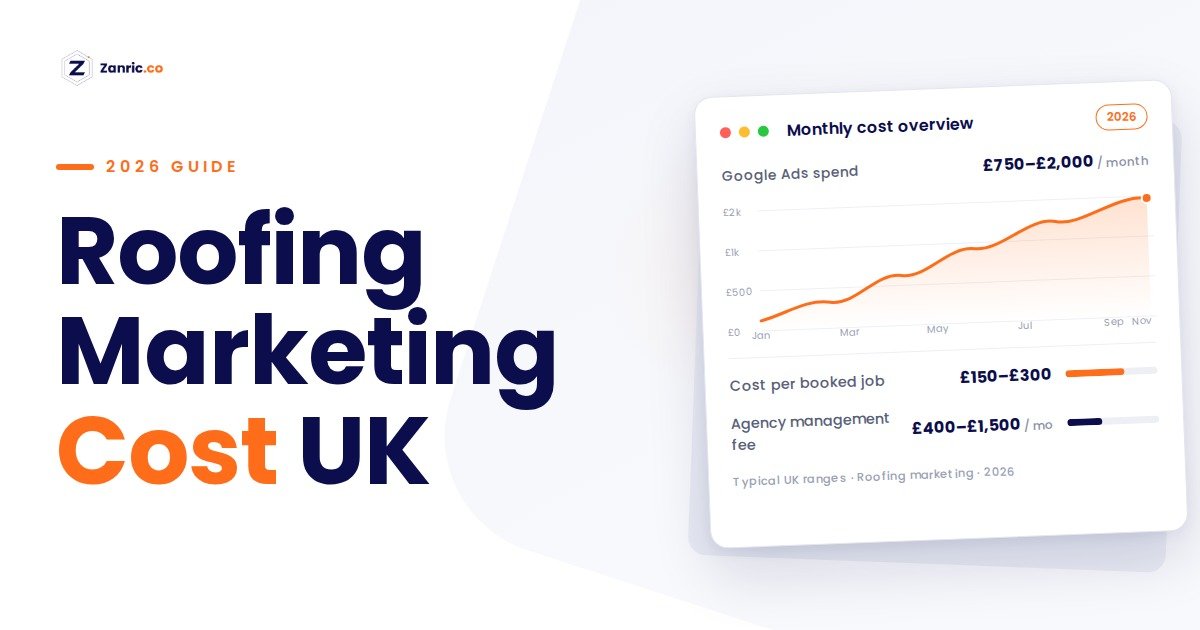
For a single-area UK roofer, a realistic starting range is £750 to £2,000 a month in ad spend, paid straight to Google (Scalepoint Digital, 2026). Roofing starts higher than plumbing or general electrical work — a re-roof is worth far more than a tap repair, so the market lets a roofer pay more for the click and the lead and still come out ahead.
Two floors to know:
- ~£500 a month is roughly the minimum ad budget for an account to gather enough data to optimise (Scalepoint Digital, 2026).
- Below ~£300 a month, most trades do not get enough clicks to learn anything (UK Roofing Leads' 2026 Google Ads guide) — the account never gets out of the guessing stage.
Take a £900-a-month budget as the walk-through — our own example, using the published conversion rates. At £30 to £60 per lead (Scalepoint Digital, 2026), £900 buys 15–30 leads; at £150 to £300 per booked job on ad spend alone, that is 3–6 jobs won — assuming a 20% close rate, which is the midpoint of the shared-lead range below. Add a management fee and the all-in cost per booked job is higher — £217–£800 a job on a £400–£1,500 fee. As the account optimises, the cost per lead falls toward £30–£45, so the same £900 buys more leads and more jobs. UK Roofing Leads (March 2026) puts a healthy cost per booked job at £60–£180, depending on city and job type. On a £3,500 average roof replacement, that is a marketing cost of roughly 2–5% of job revenue.
Monthly retainer vs pay-per-lead
Roofers usually buy marketing in one of two ways — and they are not the same product. The comparison below is about shared pay-per-lead (directory and reseller leads split between roofers), not exclusive pay-per-lead — Google Local Services Ads and exclusive pay-per-lead providers charge per direct enquiry that only you receive, and they are a third option this guide does not price here.
- Monthly retainer — £400 to £1,500 a month for a local roofing business, typically covering Google Ads, SEO and Google Business Profile management (UK Roofing Leads, April 2026). What you are buying is the machinery that keeps producing enquiries — campaigns, local pages, reviews — and it stays yours.
- Pay-per-lead — £25 to £120 per lead (UK Roofing Leads, April 2026; Clientive, 2026), depending on job type and platform. The lead is usually shared with 2–4 other roofers (MyBuilder, Rated People, lead resellers). Checkatrade is different — it is primarily a recurring membership subscription, not a per-lead board — so its cost is a membership plus per-lead fees, not a flat per-lead price. What you are buying is a single enquiry that your competitors are chasing at the same time.
Cost per lead is the wrong comparison. Cost per won job is the one that decides. One published model (UK Roofing Leads) runs the two side by side:
| Pay-per-lead | Monthly retainer | |
|---|---|---|
| Monthly spend | £1,100 (20 leads × £55) | £1,300 (£700 fee + £600 ad spend) |
| Enquiries | 20 shared leads | 18–28 direct enquiries |
| Conversion | 15–25% (shared) | 30–45% (exclusive) |
| Cost per won job | £220 – £367 | £103 – £241 |
Per lead, the two are close — a shared lead is £55, while the retainer works out at £46–£72 a lead once the fee is included. Per won job, the retainer usually comes out ahead — an exclusive enquiry converts at roughly double the rate of a shared directory lead, so the same spend turns into more jobs. One note on the model above: it pairs a £700 fee with £600 ad spend, which is below the £750–£2,000 realistic starting range for a new account — the £600 is the model's steady-state figure, not a starting budget.
The number that matters: cost per booked job
Cost per click and cost per lead are easy to quote and easy to misread. The number to watch is cost per booked job: total marketing spend divided by jobs actually won.
Work it from the other end. A £40 exclusive enquiry that closes at 20–30% costs £133–£200 per job won — that is the maths of an enquiry only you are chasing. Now take the same £40 from a shared platform, where 2–4 other roofers are calling the same homeowner: at a 5% close rate, Clientive's worked example shows that £40 lead costing £800 per job won (Clientive, 2026). The difference is not the lead price — it is who else is holding the same lead. Close rates vary by lead type: high-intent calls close at 30–45%, paid-search form enquiries at 20–30%, directory leads at 15–25%, and cold or resold leads as low as 5%. So "roughly double" holds for exclusive (30–45%) against shared directory leads (15–25%), but not against the 5% cold-lead case — there the gap is four to six times, and the cost per won job is £800 against £133–£200.
You will see several cost-per-booked-job figures in this guide — £150–£300, £60–£180, £103–£241 and £133–£200 — because they measure different things. £150–£300 is ad spend only, at a 20% close rate. £60–£180 is UK Roofing Leads' "healthy" range on the same ad-spend-only basis, varying by city and job type. £103–£241 is the all-in retainer figure (fee plus ad spend). £133–£200 is a single £40 exclusive enquiry at 20–30%. Same label, different cost base — always check whether the fee is included.
So when an agency quotes you a cost per lead, ask the next question: "and what does that work out at per booked job, in my area, for my job types?" If they cannot answer it, they are selling you clicks, not jobs.
Budget by business size
There is one benchmark that shows up across the trades: set aside 5–10% of the annual turnover you are aiming for — not the turnover you have now — and spend it on marketing (UK Roofing Leads, March 2026). The table below is total monthly outlay (ad spend plus any management fee or retainer), not ad spend alone. Budgets below about £750–£900 a month cannot fund both a retainer and meaningful ad spend — at that level, focus on self-managed Google Business Profile, reviews and local SEO first, and add paid ads once the budget grows. Trade marketing budgets are typically nearer 1–3% of turnover, so treat the 5–10% figure as an upper planning benchmark, not a rule — the tiers below are practical starting points, not a direct read-off from that percentage. Here is what that looks like as a monthly budget at each stage of a roofing business:
| Stage | Monthly budget | Focus |
|---|---|---|
| Sole trader / new starter | £200 – £500 | Google presence from zero — below the ~£500 optimisation floor, so expect slow, early-stage enquiries rather than consistent leads |
| Small team (2–4 people) | £500 – £1,200 | Steady enquiries, reviews, local SEO — the bottom of this tier (£500–£900) cannot fund both a £400 retainer and £500+ ad spend; start at £900+ for both |
| Growing firm (5–10 people) | £1,200 – £2,500 | Multiple job types, wider catchment |
| Established firm (10+ people) | £2,500 – £5,000+ | Scale, commercial work, brand |
One warning, as an industry estimate from UK Roofing Leads (March 2026): around 68% of roofing contractors have no formal marketing budget at all — no survey or sample size is published behind the figure, so treat it as an estimate, not a measured rate. Going without a budget is not a saving — it is one reason the phone often only rings when someone recommends you.
How Zanric quotes
Zanric does not publish fixed prices — every quote is custom-built around your job types, your catchment and how strong the competition already is.
What you get before any money changes hands is a free 20-minute strategy call: your current enquiries, your website and your town's competition reviewed, with the top gaps and a recommended first move in writing. If we are not the right fit, the notes are still yours to keep.
Roofing marketing cost — questions roofers ask
Sources (accessed 11 November 2026; all figures are published UK agency guides and industry benchmarks, not Zanric's own campaign results): 1. Scalepoint Digital — "Google Ads Cost for a Roofer or Builder" (2026). 2. UK Roofing Leads — "How Much Should a Roofing Contractor Spend on Marketing?" (March 2026). 3. UK Roofing Leads — "Pay Per Lead vs Monthly Retainer: What Works Better for Roofers?" (April 2026). 4. Clientive — "Roofing Leads in the UK: What's Actually Working in 2026". 5. UK Roofing Leads — "How Much Should a UK Roofer Spend on Google Ads?" (April 2026). Figures are published UK agency guides and industry benchmarks, not Zanric's own campaign results. Your actual costs depend on your area, competition and job type.